
What Is the Difference Between 50-Ohm and 75-Ohm Coaxial Cable, and Which One Should I Use?
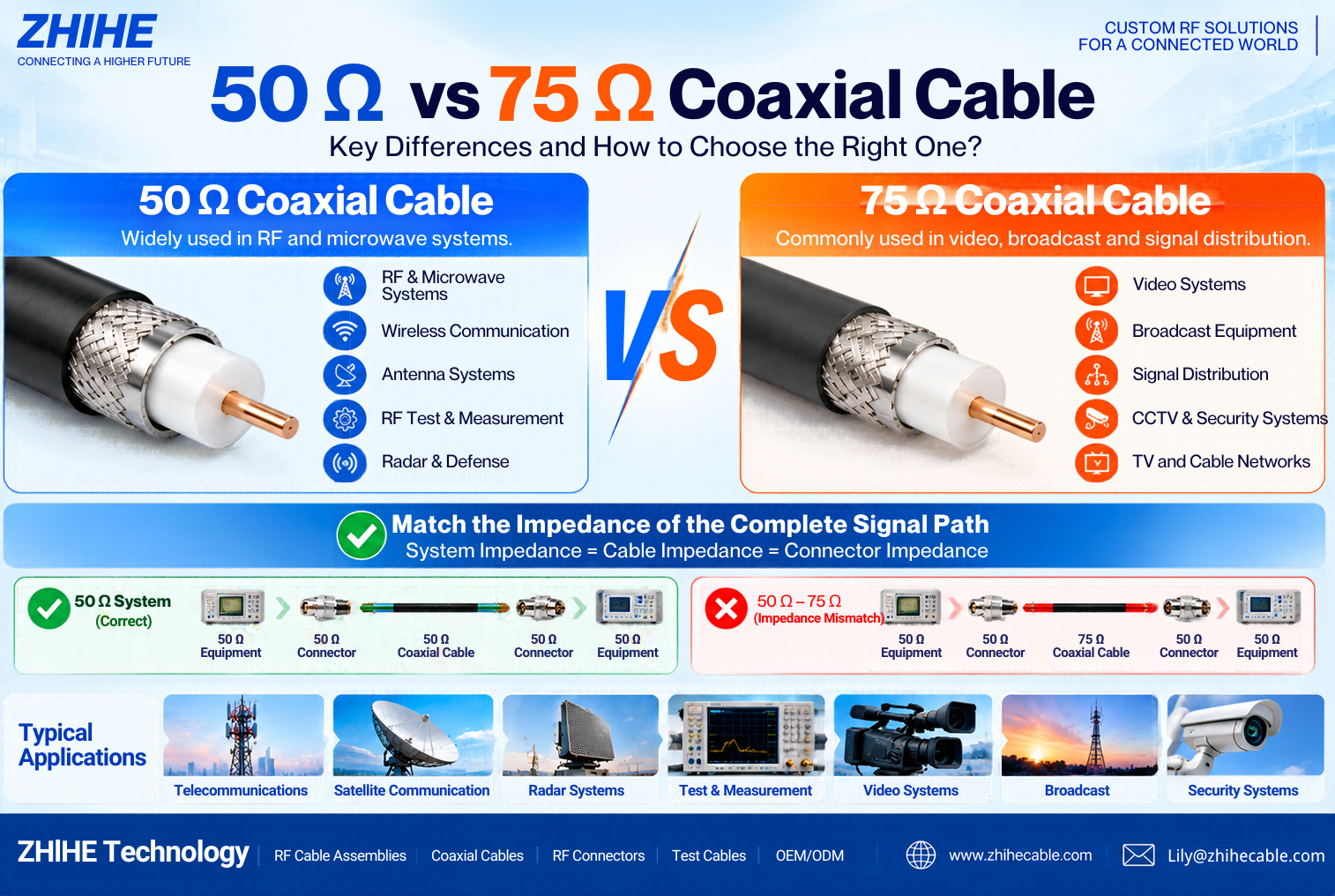
Choose the coaxial cable impedance that matches your RF system — do not select 50 Ω or 75 Ω based only on cable size or appearance.
A simple starting point is:
50 Ω → RF, microwave, wireless, antennas, RF testing
75 Ω → Video, broadcast and signal distribution
For most RF and microwave applications, 50 Ω is the common system impedance.
However, the correct choice should always follow the impedance of the equipment, connector and complete signal path.
System Impedance = Cable Impedance = Connector Impedance
1. What Does 50 Ohm or 75 Ohm Mean?
50 Ω and 75 Ω describe the characteristic impedance of the coaxial cable, not its DC resistance.
A coaxial cable consists of:
Center Conductor + Dielectric + Outer Conductor/Shield + Jacket
The dimensions and dielectric properties of these structures determine the cable's characteristic impedance.
This impedance is important because RF signals behave differently from ordinary DC current, especially as frequency increases.
2. What Is 50-Ohm Coaxial Cable Used For?
50-ohm coaxial cable is widely used in RF, microwave, wireless and test applications.
Common applications include:
RF Cable Assemblies
Antenna Systems
Wireless Communication
RF Modules
Microwave Equipment
Radar Systems
RF Test & Measurement
Many common RF connector systems are also available in 50 Ω configurations.
For an RF cable assembly, the cable and connectors should normally use the same impedance.
3. What Is 75-Ohm Coaxial Cable Used For?
75-ohm coaxial cable is commonly used in video, broadcast and signal-distribution applications.
Typical applications can include:
Video Systems
Broadcast Equipment
Signal Distribution
Certain Communication Systems
The exact cable should still be selected according to frequency, attenuation, cable size and system requirements.
A cable being 75 Ω does not automatically mean it is suitable for every 75 Ω application.
4. Why Do RF Systems Commonly Use 50 Ohms?
50 Ω has become a common impedance for many RF and microwave systems because RF equipment, cables and connectors are often designed around this impedance.
For a buyer or engineer, the most important point is not to decide whether 50 Ω is theoretically “better.”
Instead, match the cable to the existing system.
If the equipment is designed for 50 Ω:
Use a 50 Ω cable and compatible 50 Ω connectors.
This maintains a consistent impedance through the RF path.
5. Why Is 75 Ohms Common in Video and Broadcast Applications?
75 Ω is widely used in many video and signal-distribution systems.
The equipment, cable and connector interfaces in these systems are typically designed around the same characteristic impedance.
Therefore, if the equipment specifies a 75 Ω interface, the cable assembly should normally remain 75 Ω throughout the signal path.
6. Can I Use a 75-Ohm Cable in a 50-Ohm System?
A 75 Ω cable should not normally be substituted directly into a 50 Ω RF system without evaluating the impedance mismatch.
For example:
50 Ω Equipment → 75 Ω Cable → 50 Ω Equipment
creates an impedance discontinuity.
This can increase signal reflections and affect transmission performance.
The effect depends on factors such as:
Frequency + Cable Length + Application + System Tolerance
For RF and microwave applications, maintaining consistent impedance is generally the safer design approach.
7. Can I Use a 50-Ohm Cable in a 75-Ohm System?
The same principle applies in the opposite direction: a 50 Ω cable can create an impedance mismatch in a 75 Ω system.
The cable may physically connect, but physical compatibility does not mean electrical compatibility.
This distinction is especially important when choosing connectors.
Two connectors can look very similar while being designed for different system impedances.
8. Does Cable Diameter Determine Whether It Is 50 or 75 Ohms?
No. Cable diameter alone does not determine coaxial cable impedance.
Two cables can have similar outer diameters but different characteristic impedances.
Impedance depends on the internal geometry and dielectric structure, including the relationship between:
Center Conductor + Dielectric + Outer Conductor
Therefore, when a project has strict size requirements, specify both:
Required Impedance + Maximum Cable Diameter
rather than selecting a cable based only on OD.
9. Does 75 Ohm Always Have Lower Insertion Loss Than 50 Ohm?
You should not select a cable based on impedance alone when comparing insertion loss.
Actual attenuation depends on:
Cable Construction + Frequency + Length + Conductor Size + Dielectric + Materials
A specific 50 Ω cable and a specific 75 Ω cable must therefore be compared using their actual attenuation data at the required operating frequency.
For example, a useful comparison would be:
Cable A vs Cable B at 6 GHz and 1 meter
rather than simply:
50 Ω vs 75 Ω
10. Don't Forget the Connector Impedance
The connector should match the impedance of the cable and system.
A complete RF cable assembly should normally maintain consistent impedance:
Equipment → Connector → Cable → Connector → Equipment
When requesting a custom cable assembly, do not specify only the connector family.
Also provide the required impedance.
For example:
50 Ω + SMA Male to SMA Male + 500 mm + DC–18 GHz
provides much more useful information than:
SMA cable, 500 mm
Quick Selection Guide
| Application | Typical Impedance to Consider |
|---|---|
| RF Cable Assembly | 50 Ω |
| RF / Microwave System | 50 Ω |
| Antenna System | Follow system impedance |
| RF Test & Measurement | 50 Ω commonly used |
| Wireless Communication | 50 Ω commonly used |
| Video System | 75 Ω commonly used |
| Broadcast / Signal Distribution | 75 Ω commonly used |
| Existing Equipment | Match equipment impedance |
Always confirm the impedance specified by the actual equipment or system.
How to Choose Between 50 Ohm and 75 Ohm
Start with the impedance specified by your equipment.
Then check:
1. System Impedance
50 Ω or 75 Ω?
2. Operating Frequency
What frequency range must the cable support?
3. Cable Length
How long is the assembly?
4. Insertion Loss
Is there a maximum loss requirement?
5. Cable Diameter
Is installation space limited?
6. Connector Type
Which interfaces are required?
This prevents selecting a cable that has the correct impedance but does not meet the other RF requirements.
RFQ — What Information Should You Provide?
For a custom coaxial cable or RF cable assembly, please provide:
Impedance: 50 Ω / 75 Ω
Operating Frequency: ___ GHz
Cable Length: ___ mm / m
Connector A: ___
Connector B: ___
Maximum Cable OD: if limited
Insertion Loss: if specified
VSWR / Return Loss: if specified
Application: ___
Quantity: ___
If you are not sure whether your current cable is 50 Ω or 75 Ω, you can also send:
Drawing | Datasheet | Photo | Sample | Current Part Number
for technical review.
FAQ
1. Is 50-ohm or 75-ohm coaxial cable better?
Neither impedance is universally better. The correct choice is the impedance that matches the equipment and complete signal path.
2. Can I connect a 50-ohm cable to a 75-ohm system?
Physical connection may be possible in some cases, but the impedance mismatch can cause signal reflections and affect performance. For RF applications, matching the system impedance is generally recommended.
3. How can I tell whether a coaxial cable is 50 or 75 ohms?
Do not determine impedance from cable diameter or appearance alone. Check the cable specification, datasheet or part number.
4. Can ZHIHE provide both 50-ohm and 75-ohm custom cable solutions?
ZHIHE can review both 50 Ω and 75 Ω coaxial cable requirements according to the required frequency, dimensions, connectors and RF performance. Send the specifications or existing cable information for evaluation.
Need a 50 Ω or 75 Ω Coaxial Cable Solution?
ZHIHE Technology provides RF coaxial cables, custom RF cable assemblies, RF connectors and test cable solutions.
For a faster technical review, send:
Impedance + Frequency + Length + Connector A + Connector B + Application
If you are trying to replace an existing cable, you can send:
Drawing | Datasheet | Photo | Sample | Current Part Number
📧 lily@zhihecable.com
🌐 zhihecable.com